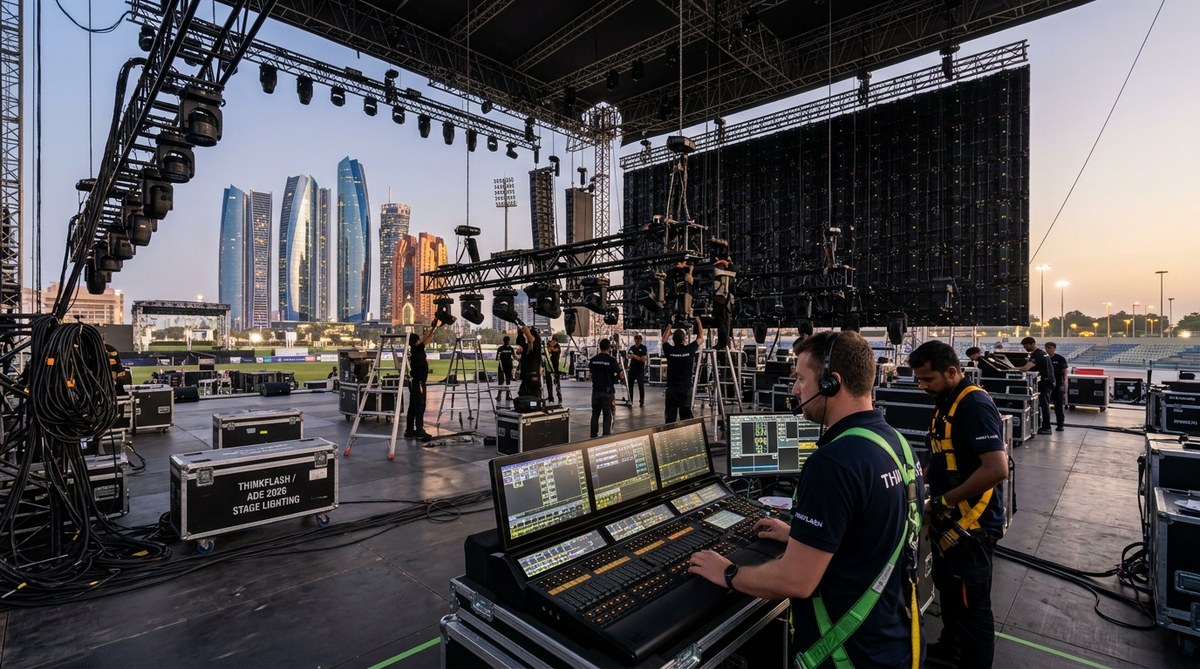
The first time you see a major stage in Abu Dhabi power up at dusk, you understand why this city has become a global reference point for live event production. The rigs are massive. The fixture counts are staggering. But what really sets Abu Dhabi festival stage lighting apart in 2026 is not just the hardware. It is the precision of the planning, the adaptation to the local environment, and the seamless fusion of light with the cultural rhythm of the audience.
Abu Dhabi festival stage lighting in 2026 relies on three pillars: extreme heat management for LED fixtures, advanced pixel-mapping for massive architectural rigs, and strict adherence to local sunset prayer timing cues. Technical directors must plan for 48 degree Celsius ambient temperatures, dust ingress from desert winds, and power grid demands that spike when air conditioning and lighting run simultaneously. Success comes from pre-visualization in specialized software and on-site redundancy.
The 2026 Lighting Workflow for Abu Dhabi Festivals
Every major festival in the capital follows a similar technical path. The timeline is compressed. The expectations are high. Here is the step by step process that lighting designers and technical directors use to deliver flawless shows.
-
Pre-visualization with environmental data. Before a single fixture ships, the entire rig is modelled in software like Vectorworks or grandMA 3D. The key difference in 2026 is the inclusion of real time weather data. Sun position, humidity, and dust forecasts are baked into the simulation. This allows the team to predict how light will scatter in the Abu Dhabi air and adjust fixture angles before the first cable is run.
-
Rigging and power load balancing. The summer months in the UAE push electrical infrastructure to its limit. Lighting designers work with local power engineers to calculate total draw. A typical main stage at a Yas Island festival might pull over 2 megawatts just for lighting. Generators are staged in dedicated compounds with active cooling. Cable runs are kept short to reduce voltage drop under extreme heat.
-
Fixture selection and thermal testing. Not every LED fixture can survive an Abu Dhabi afternoon. Units are tested for sustained operation at 50 degrees Celsius. Moving heads with sealed IP65 or higher ratings are preferred. Fans are checked for dust clogging after every 12 hour shift. The industry standard in 2026 is to run fixtures at 80% power to extend lifespan and reduce thermal stress.
-
Programming with cultural timing. The show file is built around the festival schedule. Sunset prayer times are hard stops. Lighting states are programmed to transition into a respectful dimmed mode automatically. After Isha prayer, the rig is allowed to return to full intensity. This cultural layer is non negotiable and is often the first question from local production managers.
-
On site rehearsal and calibration. The final step is a full system walkthrough with the artist’s creative team. Every cue is checked against the actual rig. Color temperatures are adjusted to account for the warm ambient light of the desert twilight. The goal is to match the pre-vis exactly.
Common Pitfalls in Desert Stage Lighting
Even experienced international teams can stumble when they first work in the UAE. The environment is unforgiving. Here are the most frequent mistakes and how to avoid them.
| Mistake | Consequence | Solution |
|---|---|---|
| Using non rated fixtures outdoors | Overheating and failure within 90 minutes | Specify IP65 rated moving heads and strobes |
| Ignoring dust ingress | Fan noise on broadcast audio and reduced output | Schedule daily compressed air cleaning |
| Overloading a single phase | Tripped breakers during peak demand | Distribute load across three phases with a certified electrician |
| Programming without sunset data | Light spill during golden hour washes out effects | Use astronomical time clocks in the console |
| Skipping cable cooling | Cable insulation melts under stage decks | Run cables in raised trays with airflow |
The Fixture Count Game: What 2026 Rigs Look Like
Walk onto the floor of an Abu Dhabi festival in 2026 and you will see a specific pattern. The rig is built in layers. The first layer is the architectural wash. Hundreds of linear LED battens are mounted on the back truss to illuminate the massive scenic elements that define Middle Eastern stage design. These battens run at 5% most of the time to keep the structure visible without blinding the audience.
The second layer is the beam package. Sharp, narrow beam moving heads cut through the dust and haze. These fixtures are the workhorses of any pop or EDM show. They create the iconic “light curtain” effect that photographers love. In 2026, the trend is toward smaller, faster fixtures that can hit 30 beams per second.
The third layer is the pixel floor. LED video tiles are laid across the stage deck. They sync with the overhead rig to create a seamless canvas. The floor is often the most challenging element because it takes direct abuse from performers, crew, and the heat rising off the stage surface.
“The biggest lesson I learned working in Abu Dhabi is that your rig is only as good as your cooling plan. We lost an entire front truss of wash lights on night one of a 2024 festival because the air handlers were undersized. Now we spec double the cooling capacity and we test every fixture at full output for four hours before the first artist steps on stage.” Senior lighting director for a major UAE festival production company.
Behind the Scenes of a Typical Load In
The load in for a major Abu Dhabi festival is a logistical operation that rivals a military deployment. Crews work in split shifts to avoid the midday heat. The morning shift runs from 6 AM to 11 AM. The evening shift starts at 4 PM and runs until midnight. The gap in between is for rest and for equipment to cool down.
The first thing that happens is the steel goes up. Truss towers are assembled on the ground and lifted into place by mobile cranes. Lighting fixtures are pre rigged on the ground in a dedicated tent. This tent is air conditioned. It keeps the electronics at a stable temperature before they are flown. Once the truss is in the air, the focus begins. This is done at night so that the team can see the actual beam output without sunlight interference.
Power distribution is handled by a dedicated team of local electricians. They run Socapex and PowerCon cables from the generator compound to the distribution racks under the stage. Every cable is taped down and covered with rubber mats to prevent tripping and to protect the cable from the heat of the stage deck.
Software and Control Trends in 2026
The control room at an Abu Dhabi festival looks different than it did five years ago. The lighting console is still the centerpiece, but it is now networked with video, audio, and automation systems over a single fiber backbone. The standard protocol is Art-Net over a dedicated VLAN. Wireless DMX is rarely used for critical rigs due to interference from the crowd’s mobile devices.
Pre-visualization software has become essential. Teams run full show simulations on laptops before a single fixture is hung. This saves days of on site programming. The software also allows remote collaboration. A designer in London can work on a show file with a programmer in Abu Dhabi in real time.
One trend that has grown fast in 2026 is the use of AI assisted cue generation. The console can analyze a music track and suggest lighting cues based on tempo, frequency, and energy. The programmer then refines these suggestions. It is not a replacement for human creativity, but it speeds up the initial layout significantly.
Why Local Knowledge Matters
Abu Dhabi is not a generic festival market. The audience has specific expectations. They expect a show that respects local culture while delivering international production value. This means lighting designers must understand the visual language of the region. Geometric patterns, warm gold tones, and a sense of grandeur are expected. The lighting should feel abundant but not chaotic.
There is also a practical side. The local authorities have strict noise and light pollution rules. Festivals in residential areas must cap their output after midnight. Light spill toward the sky is monitored. Designers must angle their rigs to keep the beam below a 45 degree elevation in certain zones.
For those looking to understand the full scope of live event production in the region, reading about how Abu Dhabi is becoming a hub for regional and international live performances will give you a broader context. The lighting is just one piece of a much larger puzzle.
The Future of Stage Lighting in the UAE Capital
Abu Dhabi festival stage lighting will continue to evolve. The push toward sustainable power is real. Solar generators are being tested for daytime side stages. Battery powered fixtures are appearing more often. The goal is to reduce the diesel generator footprint without sacrificing output.
Another shift is the use of extended reality stages. LED volumes, similar to those used in film production, are being installed in festival environments. The lighting rig must then interact with the virtual environment on the screen. This requires precise color calibration between the physical lights and the LED wall.
For technical directors and lighting designers, the message is clear. Abu Dhabi offers one of the most rewarding production environments in the world. The budgets are serious. The audiences are engaged. But the margin for error is thin. Preparation, respect for the local conditions, and a willingness to adapt are the keys to success.
Your Next Steps for a Flawless Festival Production
If you are planning a festival in Abu Dhabi in 2026, start your lighting design early. Build your pre-vis with accurate environmental data. Talk to local power engineers about grid capacity. Specify fixtures that can handle the heat. And above all, build redundancy into every critical system.
The best way to see how these principles come together is to attend a show yourself. Check out the top live music events to watch in Abu Dhabi this year and study how the lighting team handles the transition from sunset to night. Every show is a case study waiting to be read.
The work is demanding. But when that first cue hits at dusk and the crowd roars, you will know why you chose this profession.