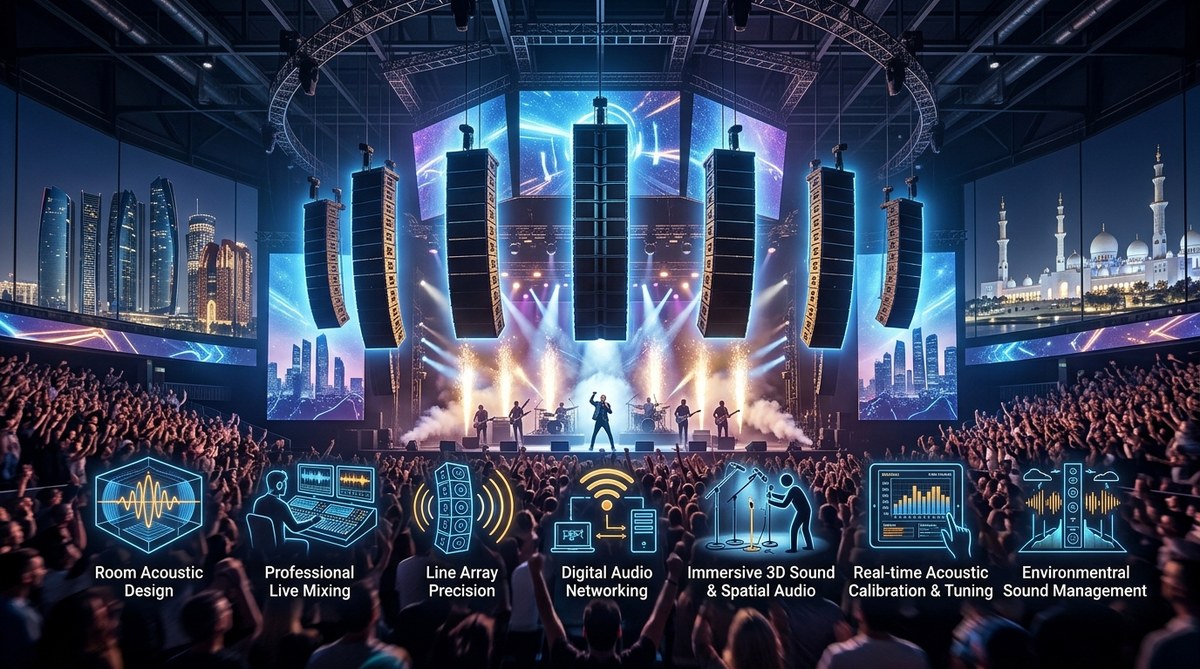
The first time you hear a full symphony at the Etihad Arena, it hits you differently. The low end doesn’t rumble in your chest like a cheap subwoofer. The vocals float, clear and untouched, as if the singer is standing right next to you. This is not an accident. It is the result of deliberate, world-class sound engineering that has quietly turned Abu Dhabi into a destination for audio perfection.
Abu Dhabi’s concert venues achieve world-class sound through seven core engineering principles: advanced room modeling, strategic speaker array design, bespoke acoustic treatments, precision delay towers, adaptive digital signal processing, rigorous noise isolation from the desert environment, and real-time system tuning. These techniques ensure every seat delivers a flawless audio experience.
The Science Behind the Silence
Before a single note plays, the venue itself must be silent. Abu Dhabi’s top venues invest heavily in structural isolation. The concrete slabs at the Abu Dhabi National Exhibition Centre are floated on rubber bearings. This stops vibrations from the Yas Marina Circuit or nearby construction from bleeding into the listening space.
Acoustic engineers call this “mass-spring-mass” construction. The outer shell of the building and the inner listening room are separated by an air gap filled with dense mineral wool. For a venue like the Etihad Arena, which hosts everything from pop concerts to classical recitals, this isolation is non-negotiable. Without it, the low-frequency rumble of an air conditioning unit could ruin a quiet piano passage.
Speaker Array Design: The Geometry of Sound
One of the biggest mistakes in live sound is treating speaker placement as an afterthought. Abu Dhabi’s engineers treat it as a mathematical problem. They use line array systems from brands like L-Acoustics and d&b audiotechnik. These are not just stacked boxes. They are carefully curved columns that create a cylindrical wavefront.
The trick is the splay angle between each cabinet. If the angle is too wide, you get gaps in coverage. If it is too narrow, you create hot spots. In venues like the Abu Dhabi Arena, engineers calculate the ideal splay for every single show. A pop act with a loud backing track needs a different dispersion pattern than an acoustic set.
Here is a breakdown of the common techniques used in Abu Dhabi’s premier venues:
| Technique | What It Does | Common Mistake to Avoid |
|---|---|---|
| Line Array Curvature | Controls vertical dispersion to avoid bouncing sound off the ceiling | Using a flat array for a deep room; it creates dead zones |
| Delay Tower Placement | Synchronizes sound arrival for rear seats | Placing towers too close to the main array, causing comb filtering |
| Subwoofer Cardioid Setup | Directs low frequencies toward the audience, not the stage | Stacking subs in a corner; it muddies the bass response |
| Acoustic Cloud Panels | Absorb early reflections above the stage | Using thin foam; it only kills high frequencies, not low mids |
| Digital Signal Processing (DSP) | Equalizes the room in real time | Applying a single EQ curve for the whole venue; each zone needs its own |
| Noise Isolation | Blocks external rumble from HVAC and traffic | Ignoring flanking paths like cable penetrations |
| System Tuning Software | Measures and adjusts output using microphones | Tuning without a reference mic; it is guesswork |
The Role of Acoustic Treatment
Concrete and glass are the enemies of good sound. They reflect high frequencies and create a “slap echo” that ruins clarity. Abu Dhabi’s newer venues have moved away from hard surfaces. The design of the newly renovated Emirates Palace Auditorium uses curved wooden diffusers. These scatter sound waves evenly instead of reflecting them directly back.
For older venues, engineers apply temporary acoustic panels. These are large, fabric-wrapped boards that absorb mid-range frequencies. They are hung from rigging points on the ceiling. A well-treated room allows the sound engineer to use less system gain. This means less feedback and a cleaner mix for the audience.
“The best sound system in the world is useless if the room is fighting against it. In Abu Dhabi, we spend 40% of our budget on acoustic treatment before we even plug in a speaker.” – Senior Acoustic Consultant, Abu Dhabi Events Authority
Real-Time System Tuning
This is where the magic happens. Before the doors open, the engineering team runs a process called system alignment. They use measurement microphones placed at multiple points in the audience. They play pink noise through the system and analyze the frequency response on a software platform like Rational Acoustics Smaart.
The goal is to get a flat frequency response across the entire listening area. In practice, this means adjusting the equalizer for each zone of the venue. The front row might need a slight cut in the high frequencies. The balcony might need a boost in the low mids to compensate for distance.
Here is the numbered process that venues like the Abu Dhabi Arena follow:
- Measure the room’s natural resonance by playing a sine sweep and recording the impulse response.
- Apply corrective EQ to remove any peaks or nulls caused by the room geometry.
- Align the delay towers so that sound from the main array and the towers arrives at the same time.
- Set the subwoofer crossover to blend seamlessly with the main speakers.
- Run a full-system check with a live band or recorded tracks to verify the mix translates well.
Adapting to the Desert Environment
Abu Dhabi’s climate presents a unique challenge. High humidity and temperature fluctuations affect the speed of sound. On a humid summer night, sound waves travel differently than on a cool winter evening. Engineers account for this by using weather-compensated DSP settings.
They also protect the equipment. Amplifiers and digital consoles are kept in climate-controlled rooms. Cables are rated for outdoor use to prevent degradation from the sun. For outdoor venues like the du Arena on Yas Island, wind and dust are constant concerns. Microphone windscreens and ruggedized speaker enclosures are standard gear.
Why Artists Love the Abu Dhabi Sound
When a touring artist’s front-of-house engineer walks into an Abu Dhabi venue, they notice the difference immediately. The room is predictable. The system is tuned. They spend less time fighting the room and more time crafting the mix. This is why major tours often add Abu Dhabi dates even when the market is smaller than Dubai.
The reputation spreads through the touring community. A good venue makes the engineer’s job easier. An easy job means a better show. A better show means the artist wants to come back. This cycle has made Abu Dhabi a must-stop on the global touring circuit.
Planning Your Next Visit
If you are an event planner looking to produce a show in Abu Dhabi, start your planning early. The best venues book their engineering teams months in advance. You will want to request a site visit with the venue’s head of audio. Walk the room. Listen to the system. Ask about the DSP settings for the specific genre of music you are producing.
For fans, the takeaway is simpler. Trust the venue. If you are seeing a show at the Etihad Arena or the Abu Dhabi Arena, you are in good hands. The engineering team has already done the hard work. All you need to do is pick a seat and enjoy the clarity. For a full list of upcoming shows, check out our guide to top live music events to watch in Abu Dhabi this year.
The Future of Live Sound in the Capital
Abu Dhabi is not stopping at current technology. The next wave of venues is being designed with object-based audio in mind. This is the same technology used in Dolby Atmos movie theaters. It allows the sound engineer to place individual instruments in three-dimensional space. A guitar can sound like it is coming from above the audience. A vocal can move from the front to the back of the room.
The Abu Dhabi Department of Culture and Tourism is investing in this infrastructure. New venues will include ceiling-mounted speakers and advanced processing racks. This will allow for immersive experiences that go beyond traditional stereo or surround sound. It is a natural next step for a city that already prioritizes audio excellence.
For a deeper look at how the city is growing its live entertainment profile, read our piece on how Abu Dhabi is becoming a hub for regional and international live performances.
Making the Most of Your Concert Night
Now that you understand the engineering behind the sound, you can appreciate it more. Listen for the clarity in the vocals. Notice how the bass feels full but not overwhelming. Pay attention to the way the sound seems to wrap around you rather than hitting you from a single direction.
These are the hallmarks of a well-engineered venue. They are the result of thousands of hours of planning, testing, and tuning. The next time you are at a show in Abu Dhabi, take a moment to appreciate the invisible work that makes the experience unforgettable. And if you want to plan your next outing, here are top tips for enjoying unforgettable live music experiences in Abu Dhabi.
The sound you hear in Abu Dhabi’s best venues is not magic. It is math, science, and a deep respect for the art of live performance. And it is only getting better.