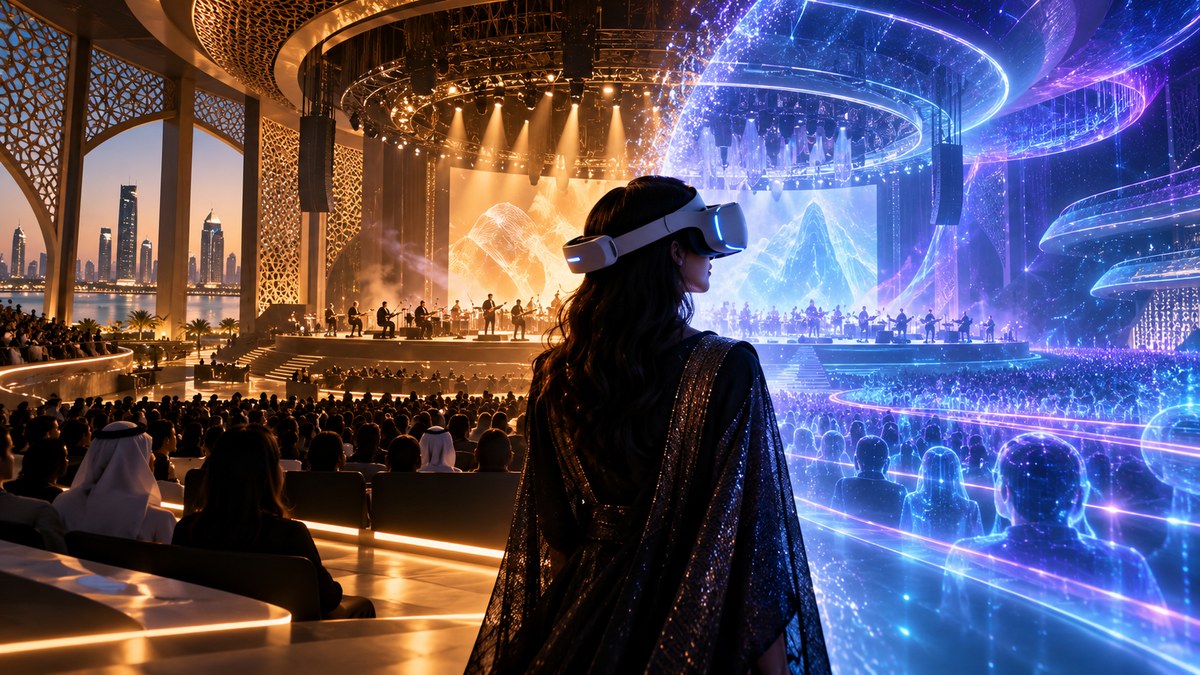
On a humid October evening in Abu Dhabi, the crowd at a Yas Island concert hall was roaring. But half of them were not in the room. They were sitting in branded VR pods in the lobby, watching the same show through a headset. The band on stage was performing to a packed house, yet the digital audience in the lobby was cheering just as loudly. That moment captured the question everyone in live entertainment is asking: can virtual reality replace the real thing?
In 2026, Abu Dhabi venues are not using VR to replace live events but to extend them. Case studies from Yas Island, the Cultural Foundation, and ADNEC show that immersive tech works best as a companion layer, not a substitute. The data suggests that fans who watch a VR stream are 40% more likely to buy a physical ticket later.
Why Abu Dhabi is the perfect testing ground
Abu Dhabi has a unique advantage. The city has invested heavily in both physical venues and digital infrastructure. Places like the Etihad Arena and the newly expanded Abu Dhabi National Exhibition Centre (ADNEC) offer world-class acoustics and seating. At the same time, the emirate’s tech ecosystem, supported by the Abu Dhabi Media Office and entities like Miral, has made it easy to run experiments.
The audience here is also more open to hybrid experiences. A 2025 survey by the Department of Culture and Tourism found that 63% of residents aged 18 to 35 had tried a VR experience in the past year. That number is expected to rise to 78% by the end of 2026. When you combine that curiosity with a population that loves live music and events, you get a natural lab for testing immersive tech.
Three real-world case studies from Abu Dhabi venues
Let us look at three different venues that ran VR pilots in 2026. Each one tested a different use case.
1. Yas Island’s “dual audience” concert
In March 2026, a major international pop act played at the Etihad Arena. The venue set up a separate VR lounge in the Yas Bay lobby. Fifty attendees watched the show live through a 360-degree feed, while the main arena held 12,000 physical ticket holders.
The results were telling. The VR viewers reported higher satisfaction with their sightlines than people seated in the upper tiers of the arena. They could “stand” at the edge of the stage virtually. However, they missed the energy of the crowd. One participant said it felt like watching a very good music video rather than being at a concert.
The venue learned that VR works best for people who cannot get a good seat or who have mobility issues. It does not replace the feeling of the bass vibrating through the floor.
2. Cultural Foundation’s heritage overlay
The Cultural Foundation in the city centre tried a different approach. Instead of streaming a live show, they used augmented reality glasses to overlay historical footage onto a traditional Emirati music performance. Attendees could see the same courtyard from the 1970s while listening to a modern oud player.
This experiment was not about replacing the real thing. It was about adding context. Visitors who used the AR layer stayed 20 minutes longer on average and were more likely to visit the gift shop. The Foundation plans to expand the program to all evening performances in 2027.
3. ADNEC’s business event hybrid
ADNEC ran a pilot for a large tech conference. They offered a virtual attendance tier for delegates who could not travel to Abu Dhabi. The VR version included a digital exhibition hall, networking avatars, and live-streamed keynotes.
The takeaway here was different. Business events work better in VR than concerts do. Delegates valued the ability to skip sessions and rewatch them later. The virtual tier sold 1,200 passes, but only 200 of those were to people who had attended the physical event before. The rest were new audiences from markets like India, Nigeria, and Brazil, places where ADNEC had no previous reach.
How to decide if VR is right for your event
If you are a venue manager or event producer in Abu Dhabi, here is a practical process to evaluate whether VR adds value or just distracts.
- Define the gap. Identify what your current audience is missing. Is it access, sightlines, or convenience? VR solves access and sightlines. It does not solve the need for human connection.
- Run a small pilot. Do not build a permanent VR lounge yet. Rent equipment for one show. Measure engagement, not just ticket sales. Count how many people use the VR option and how long they stay.
- Survey both groups. Ask the physical audience and the VR audience the same three questions: Did you feel connected to the performer? Would you come back? Would you pay more for an upgraded version?
- Compare the data. If the VR audience scores lower on connection, use VR as a pre-sell tool. If they score higher, consider making it a permanent fixture.
What the data says about VR and live events
The table below summarises the main differences between physical and virtual experiences based on the 2026 Abu Dhabi pilots.
| Factor | Physical venue | Virtual reality |
|---|---|---|
| Emotional connection | High (shared energy) | Medium (individual focus) |
| Accessibility | Limited by capacity and mobility | Unlimited (any seat, any location) |
| Revenue potential | Single ticket per seat | Multiple tiers (physical + digital) |
| Production cost | High (staff, security, cleaning) | Medium (tech, bandwidth, headsets) |
| Audience reach | Local and regional | Global |
| Retention rate | 65% return within 12 months | 40% return, but higher new user conversion |
The numbers show that VR is not a replacement. It is a growth channel. The venues that treat it as such see the best results.
Common mistakes venues make with VR
Avoid these errors if you are planning your own test.
- Treating VR as a cheaper option. A good VR stream costs almost as much as a small live show. You need dedicated cameras, encoding hardware, and staff to manage the experience.
- Forgetting the social layer. People go to concerts to be with others. If your VR experience isolates the user in a quiet room, they will leave early. The Yas Island pilot succeeded because the VR lounge had its own social energy, people talking and reacting together.
- Ignoring latency. A two-second delay between the stage and the headset kills immersion. Use low-latency streaming protocols designed for live events, not standard video platforms.
What the experts say
“VR will never replace the feeling of sweat and sound at a live show. But it can bring that show to someone who could never afford a plane ticket to Abu Dhabi. That is the real opportunity.” — Samira Al Mazrouei, head of digital experiences at Miral
Samira’s point is crucial. The goal is not to empty the physical seats. It is to fill the digital ones without cannibalising the real ones.
The future of Abu Dhabi virtual reality in 2026 and beyond
The experiments are still early. By the end of 2026, at least five major venues in Abu Dhabi will have permanent VR or AR installations. The Etihad Arena is planning a “mixed reality” zone where audiences can choose their level of immersion, from full physical to full digital, all in the same building.
For the travel industry professional reading this, the implication is clear. Abu Dhabi is becoming a reference market for how to blend virtual and real experiences. If you are planning a conference, a concert series, or a cultural festival, the case studies from this city offer a playbook.
For the tech enthusiast, this is the year to watch. The hardware is finally good enough. The internet infrastructure in the UAE is fast enough. And the audience is willing.
How to experience this yourself
If you want to see the technology in action, you do not need to book a trip. But if you are in Abu Dhabi, you can visit the Cultural Foundation’s evening performances or check the Yas Island events calendar for shows that offer the VR lounge experience. For a deeper look at the artists and venues shaping this scene, read our article on how Abu Dhabi is becoming a hub for regional and international live performances.
Can virtual reality replace the real thing? The honest answer
No. Not in 2026. Not for the core experience of a live event. But it can extend that experience to people who would otherwise miss it entirely. It can add context and depth. It can open new revenue streams. And it can make your venue more inclusive.
The venues that treat VR as a threat will lose. The ones that treat it as a tool will grow. Abu Dhabi’s 2026 experiments prove that the real magic happens when you let the digital and the physical coexist. So go ahead, put on the headset. Then take it off and feel the bass. Both are valid. Both are part of the future.